The Air We Breathe
Published

What Are Volatile Organic Compounds? (VOCs)
Volatile Organic Compounds (VOCs) are among the most common, and least understood, indoor air contaminants. Released from everyday products, furnishings, and building materials, these invisible gases can affect occupant health, comfort, productivity, and overall building performance.
As organizations increasingly recognize that indoor air quality is an asset, understanding how to identify and reduce VOCs has become an important part of creating healthier, higher-performing buildings.
What Are VOCs?
Volatile Organic Compounds (VOCs) are a large family of carbon-based chemicals that readily evaporate into the air at room temperature. Because they easily become airborne gases, VOCs can accumulate indoors—particularly in modern buildings designed for energy efficiency with tighter building envelopes and lower natural air exchange.
While some VOCs occur naturally, most indoor VOCs originate from manufactured products and building materials.
Common examples include:
• Formaldehyde
• Benzene
• Toluene
• Xylene
• Acetone
• Ethylene glycol
• Perchloroethylene
• Methylene chloride
• Hexane
• Limonene
Many of these compounds continue to be released over time through off-gassing, making VOC exposure an ongoing indoor air quality challenge rather than a one-time event.
VOCs Are Everywhere Indoors
Unlike outdoor pollution, indoor VOCs often originate from the very products intended to improve or maintain our buildings.
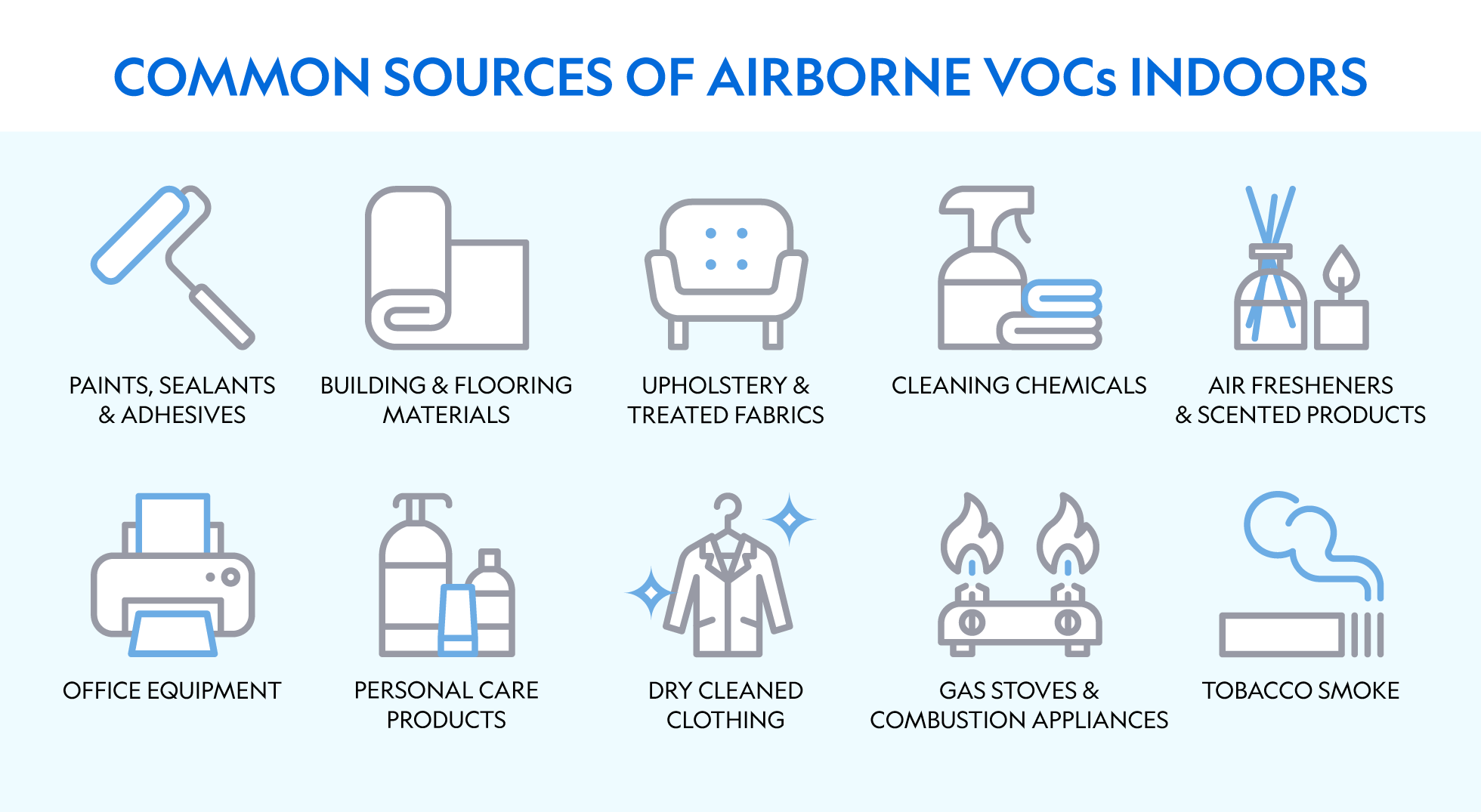
Common sources include:
• Paints, sealants and adhesives
• Flooring and composite wood furniture
• Upholstery and treated fabrics
• Cleaning and disinfecting chemicals
• Air fresheners and scented products
• Office equipment such as printers and copiers
• Personal care products
• Dry-cleaned clothing
• Gas stoves and combustion appliances
• Tobacco smoke
Even new construction and renovation projects can temporarily elevate VOC concentrations as new materials cure and off-gas.
Because people spend approximately 90% of their time indoors, these everyday emission sources deserve greater attention when developing an indoor air quality strategy.
VOCs Matter Beyond Occupant Comfort
Many people associate VOC exposure with unpleasant odors or occasional headaches, but the effects can extend far beyond comfort.
Short-Term Exposure
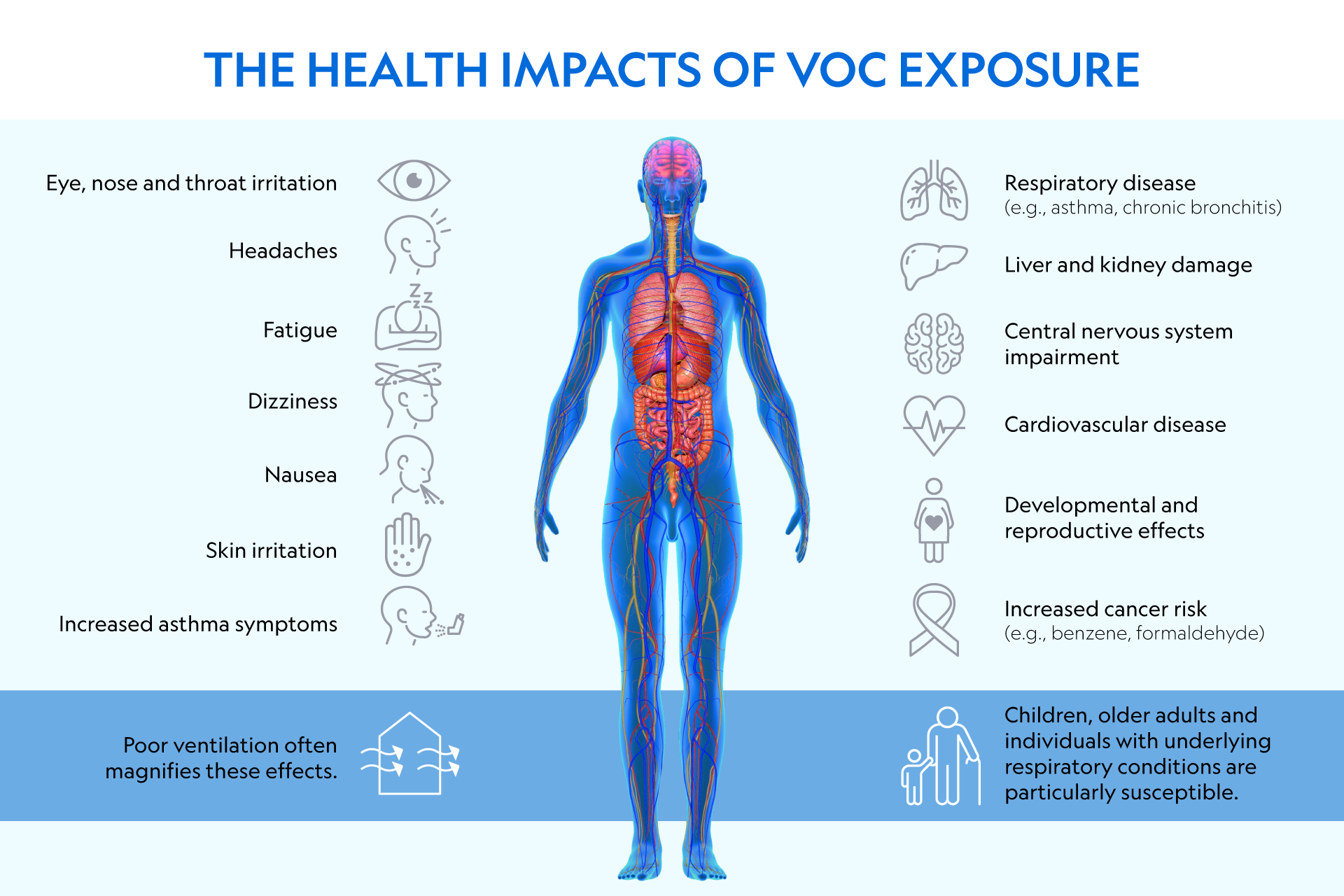
Elevated VOC concentrations may contribute to:
• Eye, nose and throat irritation
• Headaches
• Fatigue
• Dizziness
• Nausea
• Skin irritation
• Increased asthma symptoms
Poor ventilation often magnifies these effects.
Long-Term Exposure
Prolonged exposure to certain VOCs has been associated with:
• Respiratory disease
• Liver and kidney damage
• Central nervous system impairment
• Cardiovascular disease
• Developmental and reproductive effects
• Increased cancer risk from compounds such as benzene and formaldehyde
Children, older adults and individuals with underlying respiratory conditions are particularly susceptible.
VOCs Can Impact Building Performance
Indoor air quality is no longer viewed solely as an environmental health issue.
Research continues to demonstrate that healthier indoor environments can influence occupant satisfaction, cognitive performance, absenteeism, and overall building value.
While particulate matter often receives the greatest attention, gaseous contaminants such as VOCs represent another critical component of indoor environmental quality.
For organizations pursuing healthy building certifications or sustainability initiatives—including WELL, LEED, and RESET Air—understanding and managing VOC concentrations is increasingly becoming part of broader building performance strategies.
Ventilation Alone Isn't Enough
Ventilation remains one of the primary methods for reducing indoor contaminants.
Standards such as ASHRAE Standard 62.1 provide guidance for delivering acceptable indoor air quality through proper outdoor air ventilation.
However, ventilation alone cannot always solve VOC challenges.
Outdoor air may itself contain pollutants from traffic, industrial emissions, or wildfire smoke. Increasing outdoor air also comes with an energy penalty, particularly during extreme heating and cooling seasons.
As a result, many building owners are adopting layered IAQ strategies that combine ventilation with filtration, gas-phase air cleaning, purification technologies, and continuous monitoring.
HVAC Filters Don't Remove VOCs
Mechanical HVAC filters, including high-efficiency MERV filters, excel at capturing airborne particles such as dust, pollen, and fine particulate matter.
VOCs are different.
Because they exist as gases rather than particles, they pass directly through traditional particulate filters.
This distinction is important because improving particulate filtration alone does not necessarily improve gaseous contaminant control.
Effective VOC reduction requires technologies specifically designed to address airborne gases.
VOC Reduction: A Layered Approach
The most effective indoor air quality strategies combine several complementary technologies.
Source Control
Whenever possible, selecting low-emitting construction materials, furnishings, paints, adhesives, and cleaning products helps reduce VOC generation before contaminants enter the indoor environment.
Ventilation
Proper outdoor air ventilation dilutes indoor contaminants and remains a foundational element of IAQ design under ASHRAE 62.1.
Gas-Phase Filtration
Activated carbon filtration is widely recognized as one of the most effective technologies for removing gaseous contaminants.
Unlike mechanical filters, activated carbon contains millions of microscopic pores that adsorb VOC molecules, helping reduce airborne chemical concentrations before they recirculate throughout the building.
Air Purification
Modern air purification systems increasingly combine multiple technologies into a single solution.
High-efficiency particulate filtration, activated carbon media, and properly engineered soft ionization technologies can work together to address a broader spectrum of indoor contaminants.
Soft ionization has been shown to promote oxidation reactions that can reduce certain VOCs while also helping reduce airborne particulate matter. When incorporated as part of a comprehensive IAQ strategy, these technologies complement, not replace, ventilation and filtration.
Continuous Air Quality Monitoring
Perhaps the most significant advancement in indoor air quality is the ability to continuously monitor environmental conditions.
Real-time IAQ monitoring allows building operators to track Total Volatile Organic Compounds (TVOCs) alongside particulate matter, carbon dioxide, temperature, humidity, and other key indoor environmental parameters.
Instead of relying on occupant complaints, facility managers gain actionable data that helps validate ventilation performance, identify VOC spikes following cleaning or renovations, and optimize building operation over time.
Smarter Buildings Need Better IAQ Data
The future of healthy buildings isn't simply cleaner air—it's better visibility.
As building systems become increasingly connected, indoor environmental data is becoming as valuable as information about energy use, occupancy, or HVAC performance.
Understanding VOC trends allows organizations to make smarter operational decisions, verify the effectiveness of ventilation and purification strategies, and continuously improve indoor environmental quality.
Indoor air quality is becoming measurable, manageable, and increasingly strategic.
Create Healthier,
Higher-Performing Buildings
Volatile organic compounds are an invisible but significant contributor to indoor air pollution.
Fortunately, they can be effectively managed through a layered strategy that combines source control, ventilation, gas-phase filtration, air purification, and continuous air quality monitoring.
For building owners, engineers, and facility managers, reducing VOC exposure isn't simply about improving air quality—it's about supporting healthier occupants, protecting long-term building performance, and creating indoor environments that work better for everyone.
As expectations for healthier buildings continue to evolve, managing VOCs will remain a critical component of any comprehensive indoor air quality strategy.
Learn More
Whether you're designing a new facility, upgrading an existing HVAC system, or pursuing healthy building initiatives, understanding airborne VOCs is an important first step toward creating healthier indoor environments.
WellAir's integrated portfolio of sensing, purification, filtration, monitoring, and optimization technologies helps organizations gain greater visibility into indoor air quality while supporting healthier, higher-performing buildings.
Read more:
The Air We Breathe: Particulate Matter
The Air We Breathe: Bioaerosols
The Air We Breathe: Allergens and Pollens