

Resilient Buildings Start with Cleaner Indoor Air
Today's buildings face growing environmental challenges—from worsening outdoor air pollution and wildfire smoke to evolving biological threats and changing occupant expectations.
WellAir helps organizations strengthen resilience through continuous monitoring, intelligent air cleaning and measurable indoor air quality strategies that help teams anticipate risk, validate performance and document how buildings respond as conditions change.
What Is IAQ Resilience?
Resilience is the ability of a building to adapt, respond, and continue operating when environmental conditions change.
Indoor Air Quality Resilience combines continuous monitoring, intelligent air cleaning, and performance validation to help organizations prepare for airborne risks—and document how the building responds.
This measurable approach helps organizations manage risks to occupants, operations, and building assets. It also creates a documented record of indoor air quality conditions and mitigation activities that can support compliance reporting, demonstrate due diligence, and strengthen confidence among owners, occupants, insurers, and other stakeholders.

Why It Matters
Indoor air quality resilience helps organizations protect occupants, reduce operational disruption, and prepare buildings for the environmental challenges of today—and tomorrow.
 91% of urban residents breathe air that exceeds health guidelines.
The World Health Organization estimates that 91% of people living in urban areas breathe air that exceeds recommended pollution guidelines, increasing the importance of creating healthier indoor environments where people live, work, learn, and heal.
 68% of the global population will live in urban areas.
By 2050, nearly 68% of the world's population is expected to live in urban areas, increasing exposure to air pollution, wildfire smoke, and other environmental stressors while placing greater demands on healthier, more resilient buildings.
 10x more toxic than urban air pollution, wildfire smoke.
Research from Stanford University found that particulate matter from wildfire smoke may be up to ten times more toxic than particulate matter from typical urban air pollution, reinforcing the importance of protecting indoor environments during smoke events.
 1 billion people affected by wildfire smoke.
A recent global study estimated that more than one billion people each year experience unhealthy indoor air due to wildfire smoke infiltrating homes and buildings, highlighting the growing need for resilient indoor air quality strategies.
Building Resilience
Through Environmental Intelligence

Prepared buildings begin with visibility.
Rather than reacting after problems develop, organizations gain the intelligence needed to make informed operational decisions before disruptions occur.
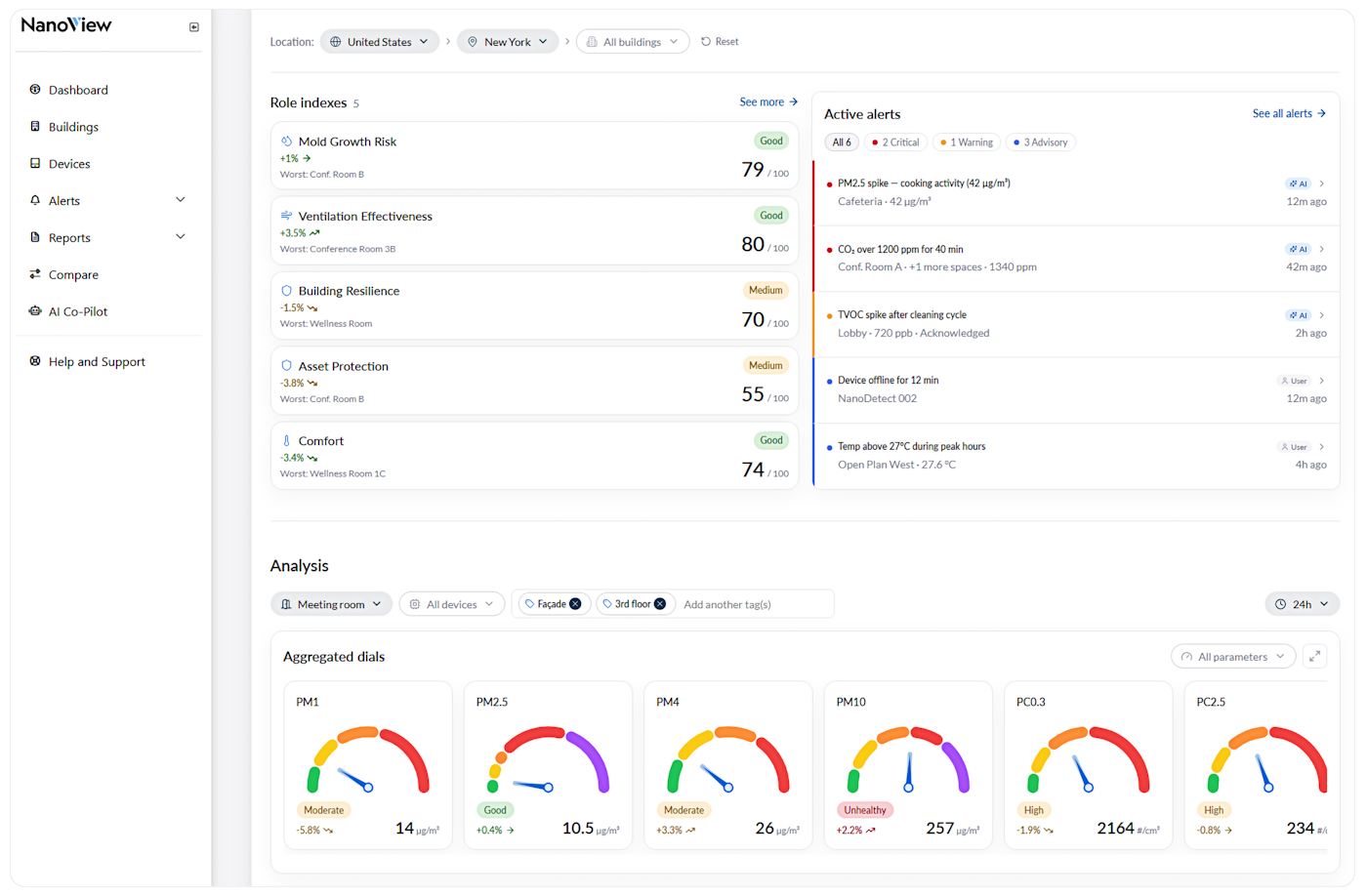
NanoDetect PRO and NanoView provide continuous visibility into indoor air quality.
Continuous environmental intelligence helps facility teams:
Detect changing conditions
Identify rising particulate levels and environmental shifts in real time.
Monitor smoke infiltration
Track outdoor threats like wildfire smoke as they enter the building.
Validate mitigation strategies
Ensure HVAC and air cleaning responses are actively working.
Respond proactively
Make informed operational decisions before disruptions impact occupants.
Eliminate reactive maintenance
Move away from relying on occupant complaints to discover air quality issues.

Solutions for Changing Conditions
Resilient buildings require different response strategies for different airborne threats.
ASHRAE Standard 241 provides a framework for reducing the risk of infectious aerosol transmission during periods of elevated risk. ASHRAE Guideline 44-2024 provides best practices for protecting building occupants from wildfire and prescribed-burn smoke.
WellAir solutions can support these strategies through continuous monitoring, HVAC air purification, portable air cleaning, performance validation, and optimization—helping building teams prepare, respond, and document results as conditions change.
Technologies That Support Risk Reduction & Resilience
Organizations prepare for resilience in different ways.
Some begin by monitoring indoor air quality during wildfire season or periods of poor outdoor air quality. Others implement HVAC air purification to improve whole-building protection, while healthcare facilities and critical infrastructure may prioritize continuous monitoring and targeted air disinfection strategies.
Every WellAir solution contributes to stronger indoor air quality resilience while providing a pathway toward a more comprehensive building strategy that adapts as environmental conditions evolve.

Prepare Today — Respond with Confidence Tomorrow
Unexpected air quality events can disrupt even well-run buildings. Talk with a WellAir expert to identify the right technologies to monitor emerging risks, respond quickly, and maintain more resilient buildings.